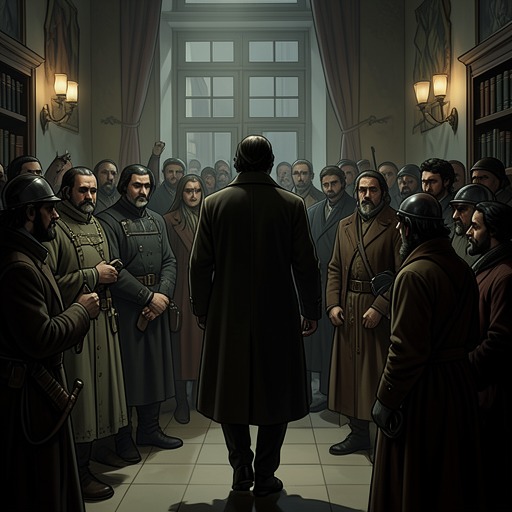
Police Chief
Dead SoulsThe Chief of Police is a prominent official in the provincial town, known less through formal descriptions of his duties than through the way he brings people, provisions, and information together. He is a civic host and a respected intermediary: his relationships with local tradesmen support his reputation, while his house becomes a gathering place for official business and, later, for the confused inquiry into Chichikov. The character’s importance lies in this double role, at once practical and social, and in the contrast between the town’s confidence in him and its inability to make sense of the crisis unfolding around Chichikov.
Office and Standing
Chichikov visits the Chief of Police among his rounds of the municipal authorities, after paying a formal call on the Governor and visiting the Vice-Governor and other officials. The call is part of his deliberate effort to establish himself in the town. He flatters the Chief of Police by praising the local gendarmery, just as he compliments other hosts on their province or administration. The Chief of Police is therefore introduced within a network of offices that Chichikov is carefully cultivating, rather than as an isolated authority figure.
The Chief of Police’s standing also rests on his familiarity with the town’s commercial life. He is described as a kind of father and general benefactor to the inhabitants, moving among them as though they were members of his family and attending to the shops and markets as though they were his own resources. His income is more than twice that of his predecessors, yet he has not lost the affection of the townspeople. Tradesmen in particular value his personal attentiveness: he becomes godfather to their children, dines in their homes, settles disputes with good humor, and asks after their families. His influence thus works through repeated personal contact as well as through his official position.
Hospitality and Local Influence
At the registration of Chichikov’s purchases, Sobakevitch proposes that the Public Prosecutor and other witnesses be summoned. The President agrees and sends a clerk to fetch them. When the formalities are complete, the Chief of Police’s home becomes the proposed destination for the gathering. The President presents him as someone who can arrange a generous meal by a brief signal to a fishmonger or wine merchant, and proposes that the party go there for food and whist. No one objects; the prospect of the fish shop’s provisions is enough to draw the witnesses along.
The scene makes the Chief of Police’s civic influence tangible. A young constable receives a quiet instruction, and while the guests play cards in an adjoining room, the dining table is supplied with sturgeon, caviare, salmon, herrings, cheeses, smoked tongue, and other food obtained from the local market and the host’s kitchen. His authority is shown not as a speech or an order issued in public, but as the ability to coordinate people and goods through a familiar, informal gesture. The same habits that make him a popular local figure also give him an unusually effective command of the town’s everyday resources.
His generosity does not make the gathering an escape from the town’s social order. It binds official work to conviviality: witnesses arrive for the registration, then proceed to the Chief of Police’s table, where eating, drinking, and conversation accompany the celebration of Chichikov’s new status as a landowner. The Chief of Police is consequently a host whose private hospitality helps sustain the public relationships on which local administration depends.
The Investigation into Chichikov
When rumors about Chichikov spread, the Chief of Police’s home again becomes the intended venue for collective deliberation. The officials remain ignorant of Chichikov’s identity despite questioning people around him. Their inquiry has produced fragments rather than clarity: Manilov praises Chichikov without explaining the transaction, Sobakevitch defends the apparent vitality of the peasants he sold while disclaiming responsibility for what might later happen, and Chichikov’s servants provide only sparse information about his state service and Customs employment. The officials conclude that they still do not know who Chichikov is, though they insist that he must be someone, and debate whether he should be detained or might himself have grounds to detain them.
The Chief of Police is designated as the host for their final debate, a choice consistent with his earlier position as the town’s social and practical center. The crisis, however, exceeds the usefulness of that network. At the meeting, the officials’ fears and competing guesses expose how little reliable knowledge they possess. Their gathering at his residence does not resolve the question; it gives collective form to their uncertainty.
The officials also turn to Nozdrev, whom they believe to be intimate with Chichikov and who first spoke of the dead-soul transaction. The Chief of Police sends a note summoning him. Nozdrev has been shut in his room for four days, occupied with marking cards, and initially resents the interruption. He agrees to come when he hears that a card novice will be visiting the Chief of Police that evening. In answering questions, Nozdrev asserts that Chichikov bought dead souls, claims to have sold him some himself, and invents further allegations, including that Chichikov is a spy and counterfeit-note forger. He also elaborates a supposed plan to abduct the Governor’s daughter, naming details of an imagined wedding and arrangements for travel.
The Chief of Police listens as Nozdrev’s account wanders into an increasingly incoherent story. Most of the officials eventually leave; the Chief of Police remains longer in the hope of learning something more, but finally signals that he cannot follow the speaker. His continued attention shows him acting as an investigator and information-seeker, yet the scene also marks the limit of his influence: even the town’s most socially connected official cannot turn Nozdrev’s confident fabrications into dependable evidence.
Narrative Significance
The Chief of Police’s character is built from a tension between reputation and method. He is genuinely beloved by the tradesmen, who appreciate his participation in their family and commercial life, and his ability to arrange the feast illustrates an effective, embodied form of local authority. At the same time, the town’s official response to Chichikov depends on conversations, personal access, and rumor as much as on formal inquiry. The same intimate connections that make the Chief of Police a capable host become channels through which uncertain stories circulate.
His home therefore links two recurring modes of provincial life: convivial exchange and official business. The registration party moves from documents and witnesses to food and whist; the later inquiry gathers around the same figure of hospitality but produces confusion rather than resolution. The Chief of Police is neither the source of the rumors nor the official who uncovers Chichikov’s true history. Instead, he embodies the town’s locally grounded authority—and the limits of that authority when sociability, speculation, and evidence become difficult to distinguish.